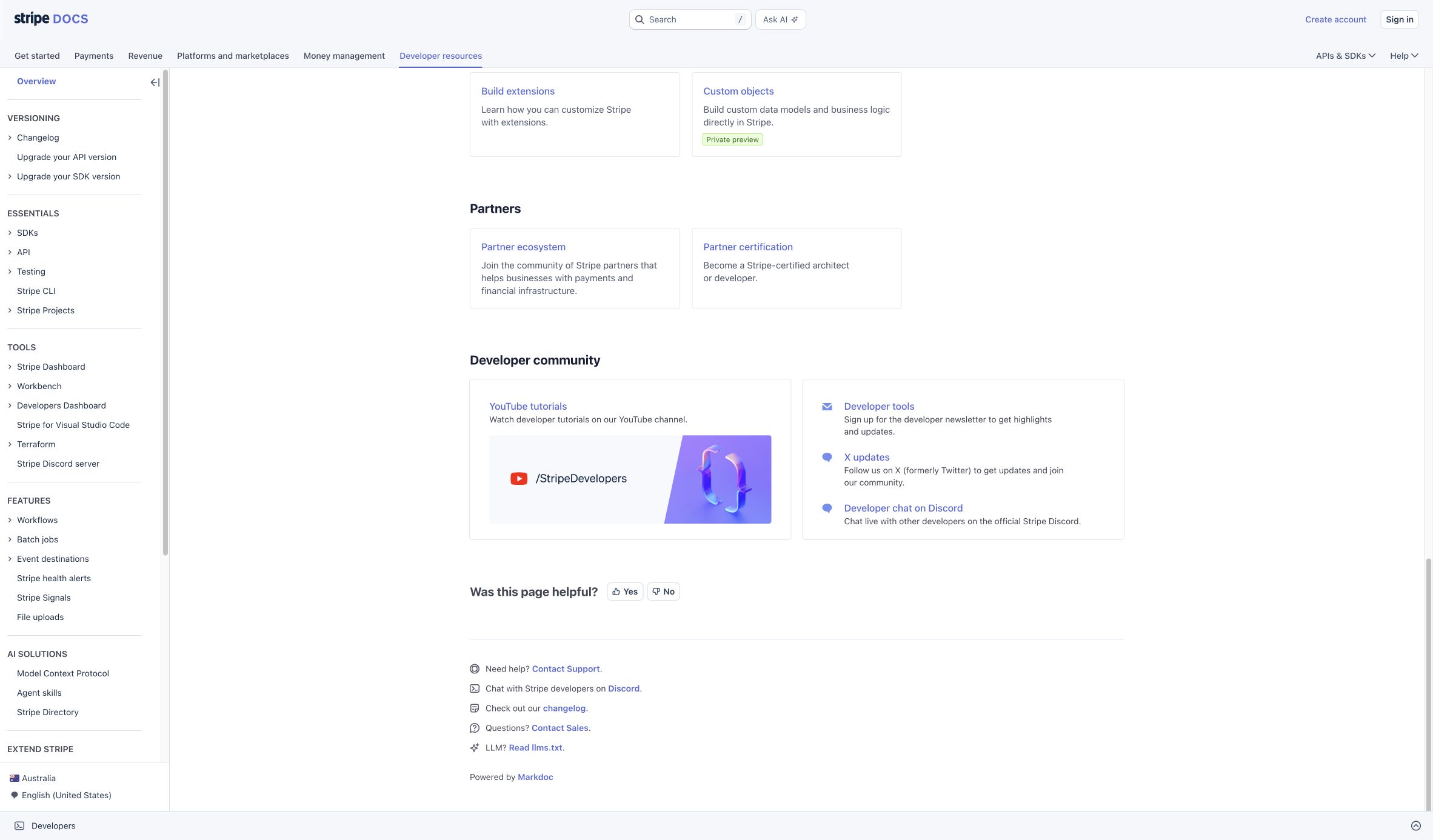
Human builder
The core idea
Reduce uncertainty at every step.
The design works because navigation, executable guidance, lifecycle context, machine-readable content, and change governance reinforce one another. The page contributes guidance; the connected system turns that guidance into action.
01 · OrientChoose the job
+
02 · ExecuteStart with code
+
03 · EvolveUnderstand change
=
Developer operating systemConfidence from first click to migration
Developer experience is not only just good documentation. It is also about mapping the intent and verified outcomes.
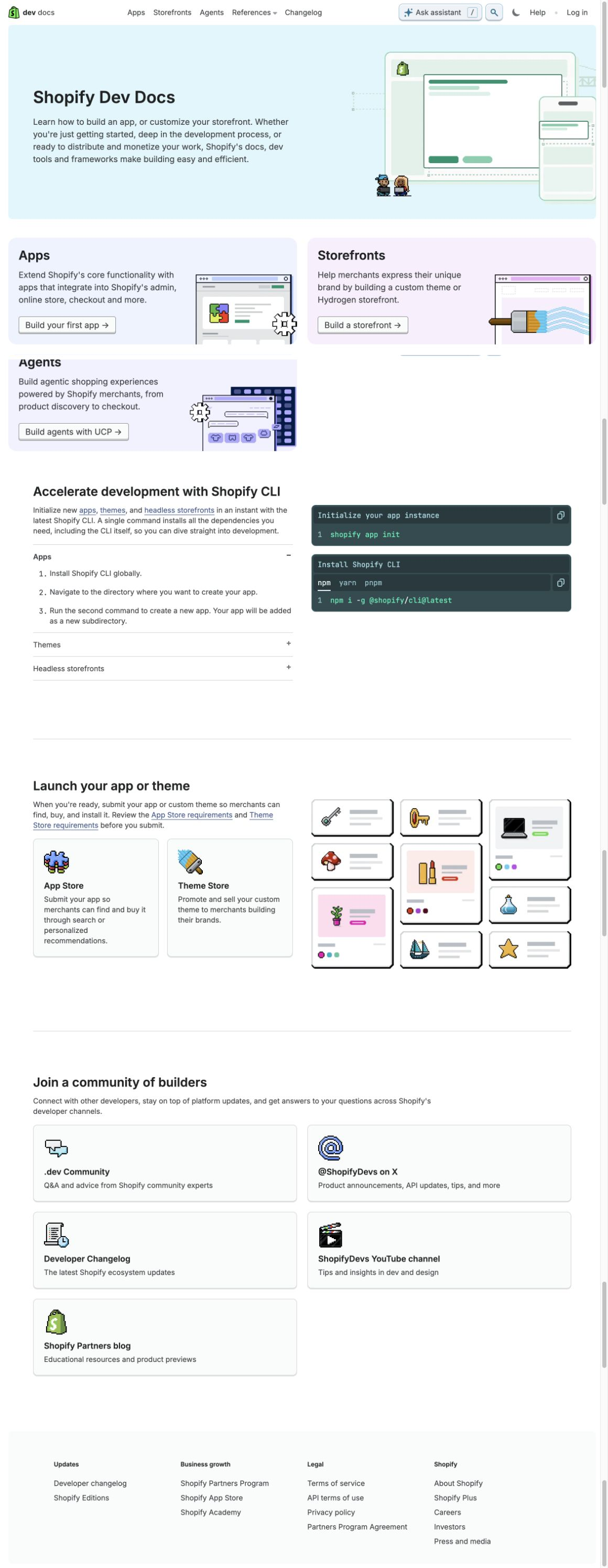
The homepage starts with jobs, then moves immediately to action.
The full page tells a coherent lifecycle: choose a surface → initialise with the CLI → understand launch requirements → join the support and update ecosystem.
Complete capture · shopify.dev/docs
Change is treated as structured product data.
The changelog is a queryable compatibility surface. Date, change type, API surface and version are visible at list level.
Complete capture · shopify.dev/changelog

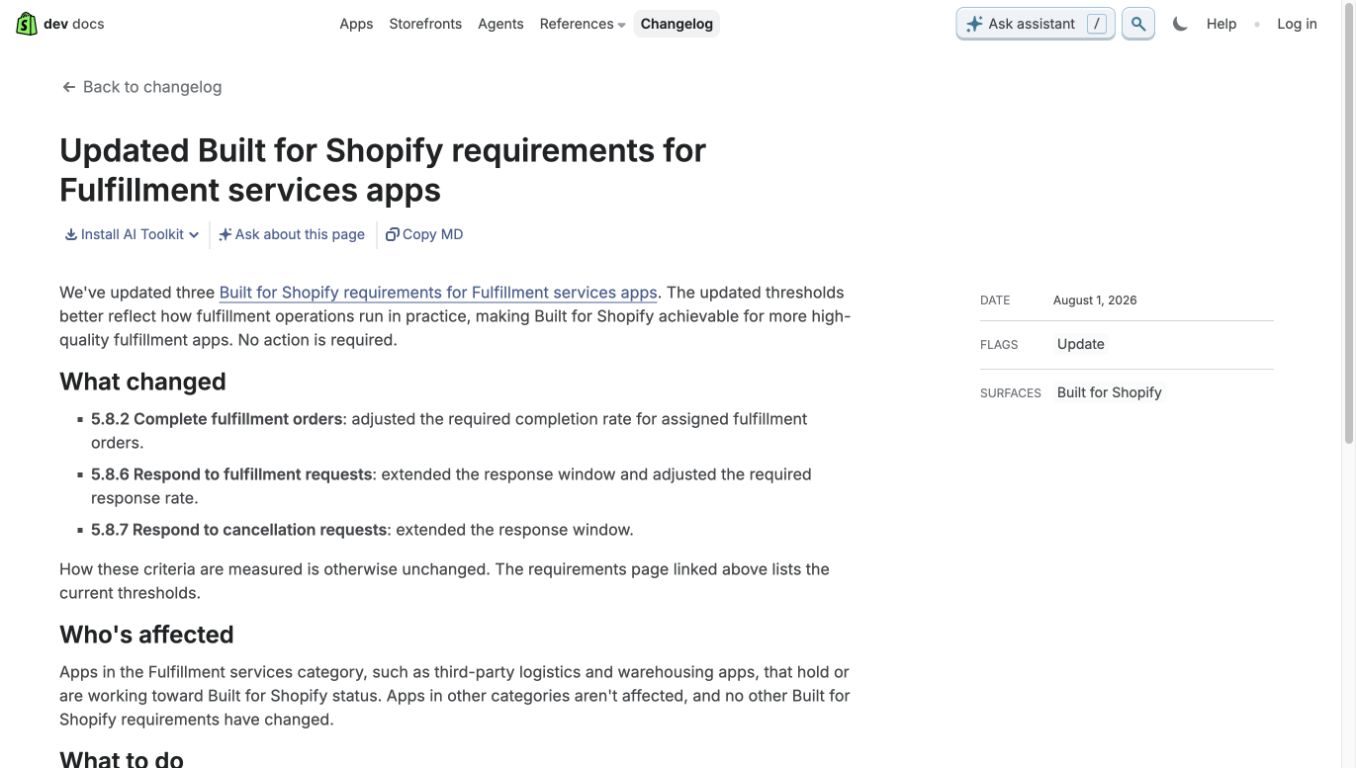
Agent-ready detail page
One page supports three modes of consumption.
The same canonical record can be read by a person, discussed with an assistant, or copied as Markdown into an external coding workflow.
- Install AI Toolkit moves context into the developer’s tool.
- Ask about this page grounds assistance in the current source.
- Copy MD gives agents clean, portable text with page chrome removed.
- Date, flag and surface remain explicit metadata.
- What changed / Who’s affected / What to do turns an announcement into an action contract.
Agent-ready means adding more authoritative context on the pages.
The relevant persona here is a coding agent—Claude, Codex or Cursor—retrieving Shopify guidance, changing an integration and proving the result. The strongest experience gives the agent authoritative context, contracts, validators and bounded ways to act.
Inference-led agent
Read page → guess intent → generate plausible code → hope.
HTMLModel memoryUnverified output
Shopify’s stronger direction
Retrieve truth → bind context → validate → act through controlled tooling → prove.
Dev MCPSchemaValidatorCLIDev store
Seven hooks move the agent from prompt to verified outcome.
Each numbered annotation identifies the Shopify mechanism and the inference it removes.
Authoritative context
AI Toolkit and Dev MCP connect the agent directly to current developer docs and API schemas.
Removes: guessing the source of truthSurface + version
Named API surfaces, versioned examples, prerequisites, scopes and environments define which contract applies to the task.
Removes: context-free “correct” answersExamples + schemas
Examples teach intended behaviour; schemas constrain fields, arguments and structures the agent is allowed to produce.
Removes: invented syntax and fieldsExecutable checks
The toolkit validates GraphQL, Liquid and extension configuration against Shopify rules before the change is trusted.
Removes: plausible-but-invalid codeBounded execution
Shopify CLI supplies authenticated store context. The agent can prepare work while the user chooses when material store actions execute.
Removes: improvised credentials and authoritySafe test reality
Dev stores, generated test data and previews let the agent verify behaviour in an isolated, realistic environment that protects live merchants.
Removes: “200 OK” as the only proofStructured change
Changelog flags, surfaces, dates, versions and migration actions let agents determine what changed and what work is now required.
Removes: production discovery of changeAgent-readable
Retrieve cleanly.
Copy MD, predictable headings and Dev MCP reduce navigation noise and ground the agent in canonical documentation.
Agent-correct
Constrain output.
Schemas, examples and validators turn likely answers into outputs that can be mechanically checked.
Agent-safe
Bound authority.
Authenticated tooling, explicit scopes, user confirmation and isolated test environments limit consequences.
Agent-aware
Track evolution.
Versions, risk labels, affected surfaces and migration steps keep the agent’s context current over time.
Readable docs help agents find information. Validation helps them act correctly.
Schemas, validators, bounded tools and test environments provide stronger correctness at each step.
Markdown
reduces parsing noise
reduces parsing noise
Examples
show intended behaviour
show intended behaviour
Schemas
constrain valid structure
constrain valid structure
Validators
check the specific output
check the specific output
Bounded tools
constrain action
constrain action
Sandbox + audit
limit and prove impact
limit and prove impact
Important distinction: Shopify’s
/agents.md, /llms.txt and /llms-full.txt update governs machine-facing storefront/theme content. Coding-agent support comes from Dev MCP, AI Toolkit, schemas, validation, CLI context and test environments.What makes the system strong.
Developer experience
Intent and taxonomy
Builders choose a job, complete an executable first move, then use concepts and reference detail to go deeper.
Agent experience
Tools for right inferences
Retrieval, schemas, validators, bounded execution and test environments help agents make checkable decisions.
Platform governance
Make change predictable
Risk labels, versions, surfaces and action templates turn compatibility into a visible product commitment.
01 / Organise by job
Start from operating intent.
Expose routes such as Build an integration, Run a shipment workflow, Configure a network and Build with agents. Place endpoints inside these job-based pathways.
02 / Create a first move
Put executable proof near the top.
A quickstart should cover authentication and end with a realistic Shippit outcome: a quote, booking, label and event.
03 / One canonical source
Serve humans and agents from the same truth.
Generate rendered docs, Markdown, OpenAPI, examples, validators and agent tools from version-controlled sources. Avoid parallel human and AI documentation estates.
04 / Make state explicit
Document workflow.
Show lifecycle states, asynchronous operations, webhooks, retries, idempotency, cancellation and reconciliation as one operating model.
05 / Encode risk
Make every change classifiable.
New, action required, breaking and deprecated must be searchable by surface and version, with affected users and deadlines stated plainly.
06 / Actionable errors
Make error messages actionable.
State what failed, why it failed and the next safe action. Include request IDs and links to relevant logs, webhook deliveries and sandbox state.
07 / Bound agent action
Design for safe delegation.
Pair machine-readable guidance with explicit scopes, tool descriptions, preconditions, confirmation boundaries, failure semantics and audit trails.
08 / Govern freshness
Make documentation a release artifact.
Release-gate schema accuracy, examples, migration guides and changelog records with clear ownership.
Build a delivery operating manual.
The Shopify pattern should be adapted to Shippit’s physical, asynchronous and multi-tenant domain. The centre of gravity is a shipment workflow that can be safely configured, observed and changed.
Start
Build
Operate
Evolve
Delivery workflow operator
Quickstart, sandbox shipment, authentication and canonical identifiers.
Quote → order → book → label → manifest → track; amend and cancel.
Lifecycle states, webhooks, retries, failures, reconciliation and support evidence.
Version compatibility, migration recipes and workflow-specific change notices.
Integration builder / technical operator
Register, validate keys, choose scopes, create test tenants and seed data.
SDKs, OpenAPI, examples, environments, rate limits and partner patterns.
Request logs, webhook deliveries, usage, permissions and diagnostics.
Changelog filters, deprecations, before/after payloads and migration testing.
Network controller
Locations, operating hours, permissions and configuration concepts.
Store settings, package allocation, dispatch locations and policy resources.
Validation, impact preview, audit history and configuration events.
Configuration compatibility, rollout controls and policy migration.
Coding agent / agent operator
Dev MCP, canonical Markdown, capability map, surface/version context and explicit scopes.
OpenAPI, event schemas, examples, validators, bounded tools and supporting prompts.
Sandbox execution, confirmation gates, machine-readable errors, correlation IDs and audit trails.
Structured changelog feed, affected workflows, migration tools and explicit action deadlines.
The minimum useful workflow-page template
01 / Intent
What job does this complete?
Outcome, actor, prerequisites, permissions, use criteria and exclusion criteria.
02 / First success
Prove it safely.
Sandbox setup, scoped key, realistic request, expected response and visible result.
03 / Lifecycle
Show the whole state model.
Sequence, asynchronous states, operation IDs, events and terminal outcomes.
04 / Examples
Teach behaviour through examples.
Happy path, validation failure, carrier rejection, timeout, retry and recovery.
05 / Observe
Show where evidence lives.
Logs, webhook delivery, request IDs, usage, permissions and reconciliation reads.
06 / Recover
Define the next safe action.
Idempotency, cancellation limits, rollback, partial failure and escalation criteria.
07 / Evolve
Name compatibility boundaries.
Current versions, deprecations, migration guide, before/after examples and deadline.
08 / Machine context
Publish the same truth cleanly.
Markdown, OpenAPI, event schemas, tool descriptions and agent safety constraints.
Change record contract
Every release answers the same questions.
This is where Shippit converts versioning from policy prose into a repeatable operating discipline.
Classification
New · Update · Action required · Breaking · Deprecated · Removed
Scope
Capability, endpoints, events, settings, SDKs and affected API versions
Audience
Affected personas, segments, partners, tenants and permission scopes
Behaviour
What changed, why, before/after payloads and semantic differences
Action
Required migration steps, owner, deadline and consequence of no action
Proof
Sandbox path, validation command, contract tests and observable success criteria
Support
Related docs, known limitations, escalation path and source-of-truth links
A practical build sequence
Phase 01 / Foundation
Define the contract of the docs.
- Name owners and release gates.
- Inventory APIs, workflows and gaps.
- Set canonical vocabulary and identifiers.
- Choose source-of-truth and generation model.
Phase 02 / First success
Make one workflow excellent.
- Create safe sandbox and scoped keys.
- Publish quote-to-track quickstart.
- Add direct key validation.
- Test examples continuously.
Phase 03 / Operability
Document reality after 200 OK.
- Expose lifecycle and async states.
- Connect logs, events and request IDs.
- Publish errors and recovery recipes.
- Cover settings and configuration.
Phase 04 / Evolution
Make change predictable.
- Launch structured changelog.
- Define version and deprecation policy.
- Publish Markdown, Dev MCP and validators.
- Instrument retrieval, failures and feedback.
Adapt from Shopify
- Job-based entry points and a persistent surface model
- Executable first success followed by deep reference
- One source serving rendered pages, Markdown and schemas
- Queryable changelog with risk, surface and version metadata
- Consistent change articles: what changed, who is affected, what to do
- Agent assistance grounded in canonical documentation
- A changelog with accountable release governance
Evidence and boundaries.
All Shopify observations are external benchmark examples. They demonstrate coherent patterns. Shippit customer demand and exact architecture require separate validation.
Primary capture
Shopify Dev DocsPrimary capture
Shopify Developer ChangelogCoding-agent operating layer
Shopify AI Toolkit and Dev MCPGovernance reference
Shopify API versioningDeveloper control plane
Shopify Dev DashboardCommerce-agent surface
Shopify Agentic CommerceMachine-facing storefront content
Agents and LLM files change recordMachine-readable detail example
Fulfillment services change record